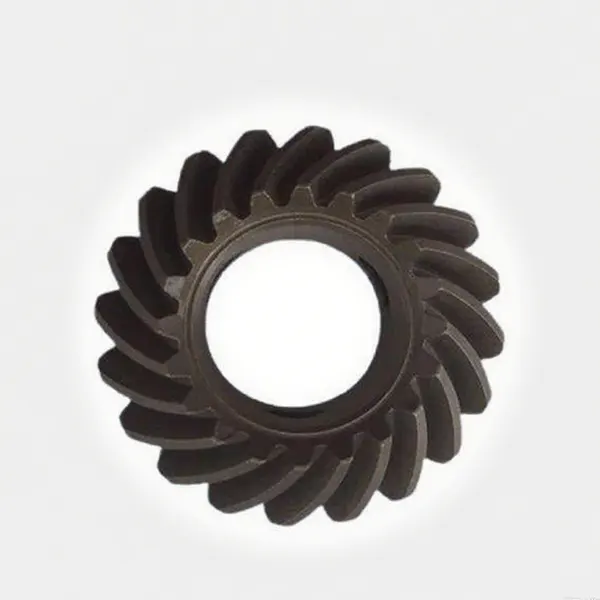
In the field of mechanical transmission, bevel gears, with their unique structural advantages, are widely used in core areas such as automobiles, industrial machinery, and aerospace. However, the manufacturing process of bevel gears – forging and casting – has a fundamental impact on their performance.
Performance Comparison: The forging process is comprehensively leading
Internal structure and mechanical properties
Forged bevel gears undergo high-temperature plastic deformation, causing metal fibers to be continuously distributed along the tooth profile direction, forming a dense and defect-free grain structure. This process endows it with high strength, high toughness, high wear resistance, and the fatigue resistance is improved by more than 30%. It is suitable for high-load and impact working conditions (such as the rotary mechanism of construction machinery and the crusher of mining machinery).
Due to the cooling and contraction of liquid metal, cast bevel gears are prone to defects such as porosity and shrinkage porosity, with coarse grains and poor directionality. Its strength, toughness and impact resistance are significantly lower than those of forgings, and it is only suitable for low-speed and light-load scenarios (such as manual valve drive devices).

Transmission efficiency and stability
The tooth surface finish of forged bevel gears reaches Ra0.8μm, the friction coefficient is reduced by 40%, the transmission efficiency is stable at over 98%, and the noise is 10-15dB lower than that of castings (for example, in automotive differentials, forged gears can achieve smooth transmission without impact).
Cast gears have a relatively high surface roughness (Ra3.2-6.3μm), large tooth profile errors, and a transmission efficiency loss of up to 5%. Moreover, they are prone to changes in tooth side clearance due to thermal expansion, which affects long-term stability.
Precision and lifespan
The forging process can achieve ISO grade 5 precision (required by the electric drive system of new energy vehicles), with a tooth surface hardness of HRC58-62 and a service life of over 100,000 hours. For instance, the high-end forged bevel gears of Double Ring Transmission achieve 200,000 hours of maintenance-free operation in industrial robots.
Cast gears are typically of ISO 8-9 grade precision, with a tooth surface hardness of HRC45-50. They have a lifespan of only 30,000 to 50,000 hours and need to be replaced regularly.

Cost and Efficiency: Short-Term Advantages of Casting vs. Long-term Value of Forging
Manufacturing cost
Casting process equipment investment is low (only 1/3 of forging), material utilization rate is high (up to 90%), and the unit cost is 40%-60% lower than that of forging. It is suitable for large-scale production of low value-added products (such as ordinary valve drive devices).
Forging processes require high-temperature heating, precision molds and subsequent processing, resulting in relatively high equipment and energy consumption costs. However, through large-scale production (such as the industrial cluster in Changzhou, Jiangsu Province, with an annual output of 18 billion yuan), the unit cost can be spread out.
Full life cycle cost
Although forged gears have a higher initial cost, their lifespan is 3 to 5 times that of castings, and the maintenance frequency is reduced by 70%. Take wind power gearboxes as an example. Forging bevel gears can reduce the total life cycle cost by 35%.

Application Scenario Decision-making Model
| Scene | 단조 베벨 기어 | Cast Bevel Gears |
| High-load/Impact Conditions | Rotary mechanisms of construction machinery, crushers in mining machinery | Manual valves, low-speed transmission devices |
| High-speed Precision Transmission | Electric drive systems in new energy vehicles, industrial robots | Ordinary reducers, low-speed fans |
| Space-constrained Environments | Auxiliary transmission systems in aero engines | Large valve drive mechanisms (requiring structural compensation) |
| Long-life Requirements | Wind turbine gearboxes, rail transit equipment | Short-term use equipment |
| Cost-sensitive Projects | Domestic substitution for high-end equipment | Temporary projects, low-frequency use scenarios |
Industry Trends: Forging technology dominates the high-end market
Technological upgrade
The electric screw press realizes automated production, reducing the unit cost by 20%.
Digital twin technology has shortened the new product development cycle by 40%, and the penetration rate of hard tooth surface processing technology has reached 67%.
Laser surface hardening has increased the service life of gears by 30%, covering 63% of large-scale enterprises.
Market demand
The demand in the fields of new energy vehicles, industrial robots and aerospace has soared. By 2025, the market size of high-end bevel gears is expected to exceed 12 billion yuan, and the proportion of forging processes is projected to reach 75%.

Conclusion: Forging technology is the core choice for high-end equipment
Forged bevel gears, with their outstanding mechanical properties, transmission efficiency and full life cycle cost advantages, have become the first choice for high-end equipment manufacturing. Although the casting process is attractive in terms of short-term cost, its performance limitations and the trend of industry upgrading have gradually led it to exit the core field. For enterprises that pursue reliability, durability and technological leadership, forging bevel gears is undoubtedly the key to investing in the future and winning the market.
Choose forging, choose long-term value!