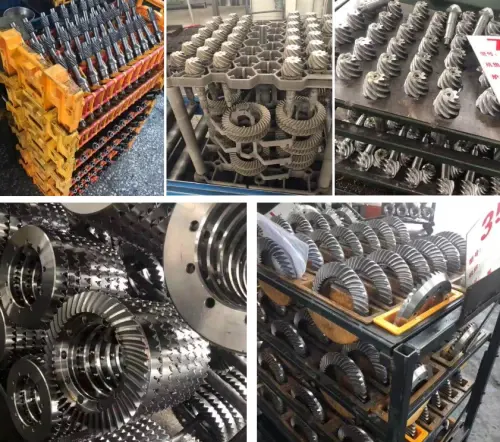
Differences in Processing Equipment and Principles
1. Spiral Bevel Gears: Traditional Bevel Gear Processing Equipment
- Equipment Type:
Commonly used Gleason or Oerlikon spiral bevel gear milling and grinding machines, processed based on the conical surface generating principle. - Key Processes:
- The cutter (cutter head) rotates around its own axis, while the workpiece rotates at a fixed transmission ratio to form a spiral tooth line.
- The axes intersect (typically 90°), and the relative motion trajectory between the cutter and the workpiece is the envelope of the conical surface.
- Typical Equipment:
Gleason 600H milling machine, Oerlikon C50 grinding machine, suitable for mass production of standardized gears.
2. Hypoid Bevel Gears: Special Offset Processing Equipment
- Equipment Type:
Special CNC bevel gear machining centers (e.g., Gleason Phoenix series) are required, based on the hyperbolic generating principle, with precise control of the eccentricity - Key Processes:
- The cutter and workpiece axes have an offset (non-intersecting), and in addition to the generating motion, the cutter’s displacement along the offset direction must be precisely controlled.
- The tooth surface is hyperbolic, and the cutter trajectory needs to simulate the envelope process of the hyperbola, requiring five-axis 联动 (X/Y/Z axes + rotation axes) control.
- Typical Equipment:
Gleason GH series CNC grinding machines with eccentricity adjustment mechanisms, suitable for high-precision complex tooth profile machining.

Comparison of Tooth Profile Processing Technologies
| Process Step | Spiral Bevel Gear | Hypoid Bevel Gear |
| Tooth Milling/Cutting | – Cutter head axis intersects workpiece axis (90°) – Cutter trajectory is conical surface generating, no offset control needed |
– Cutter head axis is offset from workpiece axis (eccentricity E) – Cutter must move along the offset direction to form hyperbolic tooth lines |
| Tooth Grinding (Precision Processing) | – Conical grinding wheel grinds along the tooth axial direction to correct heat treatment deformation – Accuracy reaches ISO 7~8 |
– Special hyperbolic grinding wheel is mandatory, grinding along offset trajectory – Higher accuracy requirement (ISO 6~7), multiple grinding corrections needed |
| Cutter Design | – Cutter head blades are radially arranged with conical cutting edges – High generalizability (same modulus can be universal) |
– Cutter head must match eccentricity parameters, blade angles relate to hyperbolic curvature – Special cutters have high costs (e.g., Gleason proprietary cutter heads) |
| Processing Efficiency | – Short single-process time, suitable for mass production | – Multi-axis linkage processing has a complex procedure and its efficiency is 30% to 50% lower than that of spiral bevel gears |
Differences in Heat Treatment and Surface Treatment
1. Spiral Bevel Gears: Conventional Carburizing and Quenching
- Process:
Low-carbon steel (e.g., 20CrMnTi) carburizing (case depth 0.8~1.2mm), quenching to achieve surface hardness HRC58~62 while retaining core toughness. - Features:
Suitable for medium-load applications (e.g., passenger vehicle differentials), prioritizing surface wear resistance over strength.
2. Hypoid Bevel Gears: Enhanced Heat Treatment + Surface Treatment
- Process:
- Deeper carburizing layer (1.2~1.8mm), higher quenching temperature (e.g., 860℃~880℃) to improve core strength.
- Often supplemented with shot peening(surface compressive stress ≥800MPa) or coating treatment (e.g., TiN plating to reduce friction coefficient).
- Rationale:
The offset design causes greater tooth surface sliding friction, requiring strengthened treatments to enhance fatigue resistance (e.g., heavy truck main reducer gears withstand over 2000N·m torque).

Precision Control and Inspection Focus
1. Spiral Bevel Gears: Emphasis on Tooth Direction and Profile Accuracy
- Inspection Items:
- Pitch cumulative error (Fp), tooth profile error (ff), tooth direction error (Fβ), using bevel gear testers (e.g., Gleason 390G).
- Application Scenarios:
General transmission (e.g., machine tools, agricultural machinery), allowing slight noise with relatively loose precision control.
2. Hypoid Bevel Gears: Emphasis on Meshing Zone and Offset Precision
- Inspection Items:
- Besides conventional precision, prioritize eccentricity error (≤0.02mm)and meshing imprint position (must cover 80% of the tooth surface midsection).
- Use five-axis CNC testers (e.g., Zeiss Prismo) for 3D scanning to verify hyperbolic tooth profiles.
- Application Scenarios:
High-speed heavy-loadsituation (e.g., aerospace, construction machinery), where poor meshing leads to early failure, requiring 100% full inspection.
Typical Cases: Machining of Automotive Main Reducer Gears
1. Spiral Bevel Gears (Passenger Vehicle Rear-Wheel Drive)
- Process Route:
Forged blank → tooth milling → carburizing and quenching → tooth grinding → shot peening → assembly - Example:
A passenger vehicle main reducer gear (transmission ratio 3.73:1), processed by Gleason 600H milling machine, with a grinding time of 15 minutes per part.
2. Hypoid Bevel Gears (Heavy-Duty Trucks)
- Process Route:
Die-forged blank → rough tooth milling → carburizing and quenching → fine tooth grinding (coarse + fine grinding in two steps) → coating (TiCN) → meshing running-in inspection - Example:
A heavy truck main reducer gear (transmission ratio 6.83:1, eccentricity 30mm), processed by Gleason GH1000 grinding machine, with a single-tooth grinding time of 45 minutes per part, requiring additional eccentricity calibration (error ≤0.01mm).
Summary of Differences: Why Different Processes?
- Geometric Essence: Spiral bevel gears are “conical surface generated,” while hypoid gears are “hyperbolic generated,” requiring more complex spatial motion control for the latter.
- Load Requirements: Hypoid gears bear greater torque due to offset design, demanding strengthened processes (deep carburizing, shot peening) for enhanced strength.
- Precision Demands: The meshing precision of hypoid gears directly affects transmission efficiency (e.g., vehicle fuel consumption), necessitating higher machining accuracy and inspection standards.